


sin rule & Cosine rule
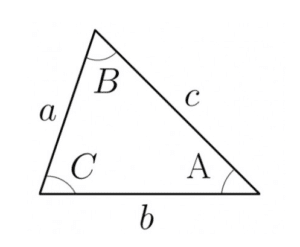
In order to use these rules, we require a technique for labelling the sides and angles of the non-right angled triangle. This may mean that a relabeling of the features given in the actual question is needed. See the non-right angled triangle given here. Angle A is opposite side a, angle B is opposite side B and angle C is opposite side c. We determine the best choice by which formula you remember in the case of the cosine rule and what information is given in the question but you must always have the UPPER CASE angle OPPOSITE the LOWER CASE side.
The Cosine Rule
These formulae represent the cosine rule. Note that it is not necessary to memories all of them – one will suffice, since a relabeling of the angles and sides will give you the others. Students tend to memories the bottom one as it is the one that looks most like Pythagoras.


We use the cosine rule to find a missing side when all sides and an angle are involved in the question. It may also be used to find a missing angle if all the sides of a non-right angled triangle are known. See Examples 1 and 2.
These formulae represent the cosine rule. Note that it is not necessary to memories all of them – one will suffice, since a relabeling of the angles and sides will give you the others. Students tend to memories the bottom one as it is the one that looks most like Pythagoras.
We use the cosine rule to find a missing side when all sides and an angle are involved in the question. It may also be used to find a missing angle if all the sides of a non-right angled triangle are known. See Examples 1 and 2.
The Cosine Rule
The Sine Rule
This formula represents the sine rule. The sine rule can be used to find a missing angle or a missing side when two corresponding pairs of angles and sides are involved in the question. This is different to the cosine rule since two angles are involved. This is a good indicator to use the sine rule in a question rather than the cosine rule. See Example 3.
Note that when using the sine rule, it is sometimes possible to get two answers for a given angleside length, both of which are valid. See Example 4.
This formula represents the sine rule. The sine rule can be used to find a missing angle or a missing side when two corresponding pairs of angles and sides are involved in the question. This is different to the cosine rule since two angles are involved. This is a good indicator to use the sine rule in a question rather than the cosine rule. See Example 3.
Note that when using the sine rule, it is sometimes possible to get two answers for a given angleside length, both of which are valid. See Example 4.
The Sine Rule

or

or
The Area of a Non-Right Angled Triangle
These formulae represent the area of a non-right angled triangle. Again, it is not necessary to memorise them all – one will suffice (see Example 2 for relabelling). It is the analogue of a half base times height for non-right angled triangles.
Note that to maintain accuracy, store values on your calculator and leave rounding until the end of the question. You can round when jotting down working but you should retain accuracy throughout calculations. See Examples 5 and 6.
These formulae represent the area of a non-right angled triangle. Again, it is not necessary to memorise them all – one will suffice (see Example 2 for relabelling). It is the analogue of a half base times height for non-right angled triangles.
Note that to maintain accuracy, store values on your calculator and leave rounding until the end of the question. You can round when jotting down working but you should retain accuracy throughout calculations. See Examples 5 and 6.
Mastering the Cosine Rule: Step-by-Step Guide
Hello students! As your math teacher, I know that moving beyond right-angled triangles can feel tricky. While Pythagoras works for 90-degree triangles, the Cosine Rule is your "Master Key" for any triangle! Whether you are preparing for GCSE, IGCSE, or O-Levels, this rule is a must-know.
🎥 Watch My Detailed Video Lesson
Before jumping into the worksheet, watch me solve these problems step-by-step.
▶️ CLICK HERE TO WATCH VIDEOWhat is the Cosine Rule?
The Cosine Rule relates the lengths of the sides of a triangle to the cosine of one of its angles. It is essential when you have SAS (Side-Angle-Side) or SSS (Side-Side-Side).
a² = b² + c² - 2bc cos(A)
Practice Worksheet
Ready to test your skills? I have prepared a comprehensive worksheet for you. You can view it below or download it for your practice.
Real-Life Application
Did you know engineers use the Cosine Rule to design bridges? It helps calculate the length of supporting beams when the angles between them are not 90 degrees.
📝 Quick Worked Example
Find side 'a' if b=8, c=10, and Angle A=60°:
a² = 8² + 10² - 2(8)(10) cos(60°)
a² = 64 + 100 - 160(0.5) = 164 - 80 = 84
a = √84 ≈ 9.17
💡 Exam Tips
- Ensure your calculator is in DEG mode.
- Remember: side 'a' is ALWAYS opposite Angle 'A'.
- Write down the formula before you start—it often earns you a mark!
